
Designing Neurodiversity-Inclusive Environments
I don’t fully understand it!
This is why I’m writing this blog. I want to learn, open my mind, and expand my knowledge.
The built environment has a big imapct on how people engage with the world, and for neurodiverse individuals, this impact is often more intense due to sensory sensitivities. Everyday features like flickering lights, loud noises, or chaotic layouts easily ignored or tolerated by neurotypical individuals can lead to sensory overload and emotional strain.
Poorly designed spaces can limit focus and reduce inclusivity. The lack of calm, predictable environments can heighten anxiety and hinder meaningful participation. This emphasises that inclusive design isn’t just about physical access it’s about supporting emotional and cognitive wellbeing. Offering a variety of sensory-friendly work environments gives employees more choice and control. (Dobstaff, n.d.)
As highlighted by Fierro-Newton (2025) and Neurotectura, integrating neuroscience with universal design helps create environments that reduce stress, enhance creativity, and foster belonging. Recognising the strengths of neurodivergent individuals, like creativity and attention to detail allows us to design spaces that benefit everyone.
Around 15–20% of people in the world are considered neurodivergent. These conditions often overlap, for example, someone with autism might also show signs of ADHD. (Charity, 2022)
We as designers need to remember that no two people experience these conditions the same way. Even if they have the same diagnosis, their needs, strengths, and challenges can be very different. (Dobstaff, n.d.)
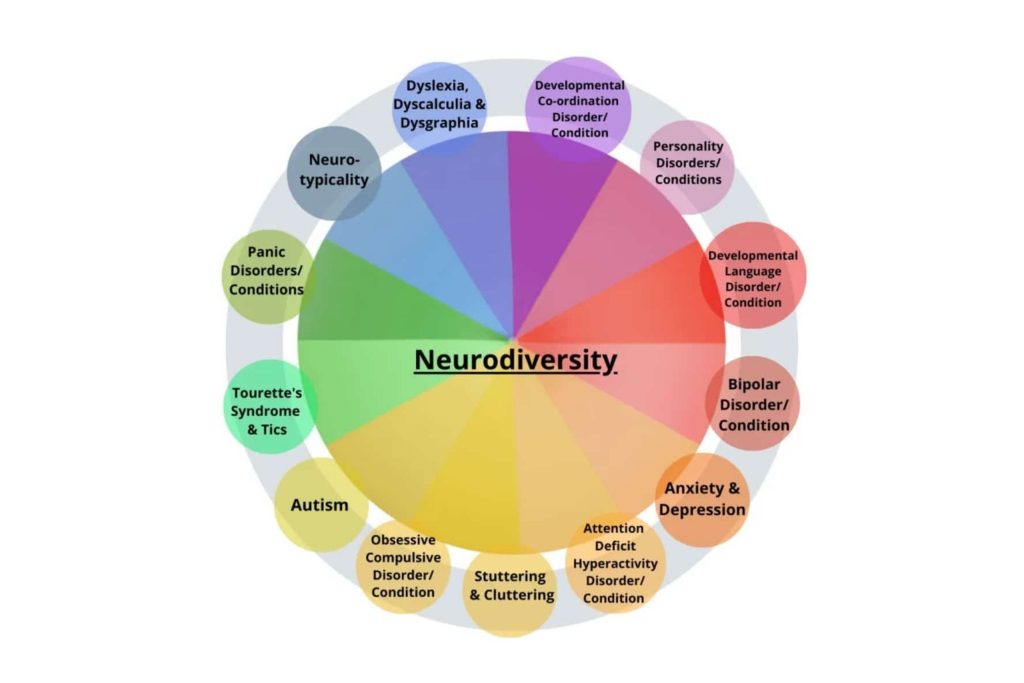
Originally the term Neurodiverse was used to describe individuals on the autism spectrum, it has now been expanded to include a wider range of neurological differences, for example ADHD, Dyslexia, Tourettes and many others. The concept questions traditional ideas of what is considered “normal,” and instead promotes a more inclusive and accepting view of the diverse ways all minds function. (Lakhan et al., n.d.) Neurodiversity means that people have different ways of thinking, learning, speaking, moving, and interacting with others. It shows that there isn’t just one “normal” way for the brain to work, everyone’s brain is unique. (Anon, 2022)
Neurological profiles can be broken into three groups.
The term neurodivergent emerged from the neurodiversity movement to describe individuals whose neurological differences such as autism, ADHD, or dyslexia, mean they don’t fit within the conventional idea of being neurotypical. Neurotypical refers to individuals whose brain function and behavior are considered standard or typical. Neurodegenerative conditions involve changes in the brain that cause a gradual loss of function, often affecting movement, thinking, memory, or the senses. These changes usually happen over time due to brain diseases such as Alzheimer’s, Parkinson’s, or Huntington’s disease.(Anon, 2022)
Meanwhile, Neurodiversity refers to the full spectrum of neurological differences and includes both neurodivergent, neurotypical and neurogenerative individuals as part of a diverse group.(Charity, 2022)
As mentioned earlier, neurodivergence refers to a range of conditions, including but not limited to autism, ADHD, dyslexia, dyscalculia, and dyspraxia. (NHS England | Workforce, training and education, 2023)
Autism affects how people communicate and interact, involving challenges with social skills, communication, and repetitive behaviors. Many autistic individuals also experience sensory sensitivities, such as being over or under-sensitive to sounds, light, or touch. Autism, often called Autism Spectrum Disorder (ASD), covers a wide range of experiences and abilities, meaning each person with autism is unique, with different strengths and challenges. .(MEd and MD, 2021)
ADHD (Attention Deficit Hyperactivity Disorder) involves difficulties with focus, hyperactivity, and impulsivity. Although often seen as a childhood condition, ADHD affects many adults worldwide. It can impact executive function, emotional control, memory, time management, sleep, and sensitivity to stress and sensory input.
“There are 2.6 million people in the UK with ADHD (708,000 children, 1,9m adults) based on The Lancet and NICE giving a childhood ADHD incidence rate of 5% and an adult ADHD incidence rate of 3-4%.” (Anon, 2022)
Dyslexia is a condition that affects how the brain processes information, often making tasks like reading, writing, and spelling more challenging. It can influence memory, language, sequencing, and how sounds are interpreted. Many people with dyslexia show strong skills in creativity and problem-solving. Around 6.3 million people in the UK, roughly 10% of the population, are thought to have dyslexia. Dyslexia often coexists with other conditions such as dyscalculia, ADD, and ADHD.(GOV.UK, n.d.)
Dyscalculia is a difficulty with understanding numbers and basic maths concepts. It can affect skills such as counting backwards, estimating, remembering number facts, and performing calculations. People with dyscalculia may struggle with place value, mental arithmetic, and mathematical procedures like long division, often leading to anxiety around maths. (Association, n.d.)
Dyspraxia, also known as Developmental Coordination Disorder (DCD), is a type of neurodivergence that affects movement, balance, and coordination. It can also influence sensory processing, memory, attention, and organizational skills, and may lead to fatigue. While each person’s experience is different, many individuals with dyspraxia are recognized for their creativity, resilience, and strong problem-solving skills.
Through research it shows that withinn the workplace, people with neurodiverse conditions face stigma and unsuitable environments. Embracing neurodiversity means focusing on strengths and providing support. (MEd and MD, 2021)
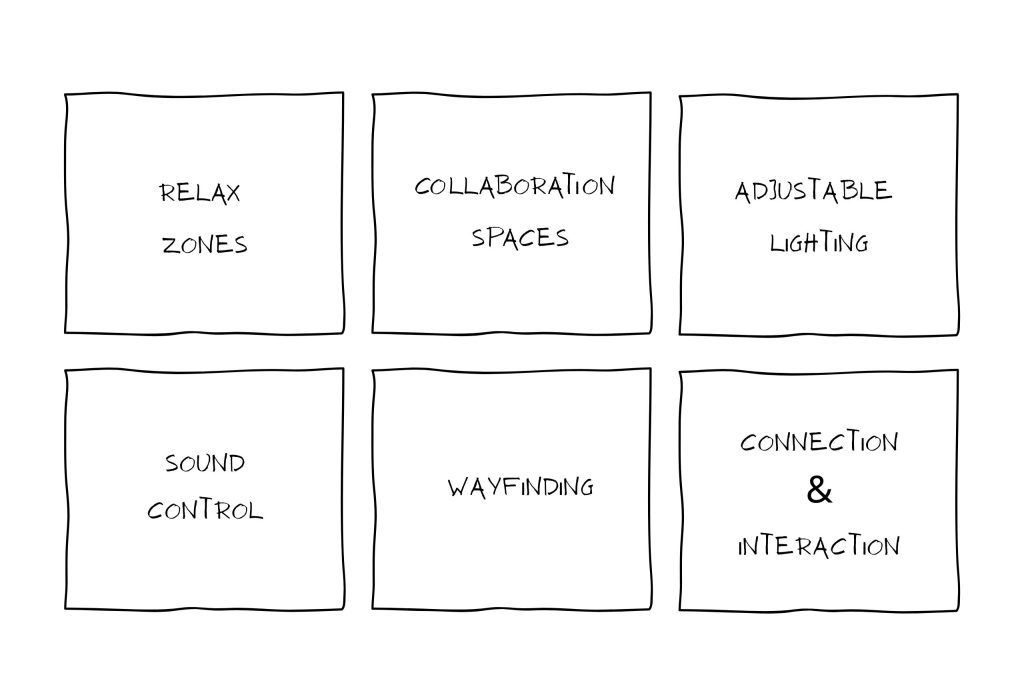
Designers can help by considering the following –
- Universal Design Principles
- Reverse Inclusion
- Transition Zones
- Spaces such as hallways and entry points can act as sensory buffers, helping users adjust between high- and low-stimulation environments.
- Layouts that face inward, such as around courtyards support calm, identity, and controlled social interaction.
- Escape Spaces
- Calming zones with minimal stimulation, where individuals can regulate sensory overload.
- Acoustic Comfort
- Sensory Zones
- Providing Clear Wayfinding
- Researching about individual needs
CONCLUSION!
This has already started to shift my understanding of how deeply the built environment shapes people’s wellbeing, especially for neurodivergent individuals. What I previously saw as “preferences” are often essential needs linked to sensory processing, emotional regulation, and how people participate in everyday life. It’s clear to me that inclusive design isn’t just a thoughtful extra, but a responsibility that architects and interior designers must take seriously.
What stands out most is that neurodivergence isn’t one experience, it is a spectrum of strengths, challenges, and sensory responses. As designers, we need to move away from assumptions and toward environments that offer choice, flexibility, and calm.
My next step is to look further into sensory design strategies, such as managing auditory and visual stimuli, tactile materials, lighting control, and zoning that supports different sensory profiles. By understanding sensory environments in more detail, I hope to design spaces that not only reduce stress, but actively celebrate and support the diversity of how people think, feel, and interact with the world.